Wednesday, October 13, 2010

Mid-Semester Summary

The first part of the Semester has been very interesting.  As I am sure I have said before, I had no idea what to expect from this class from the initial description we received over the portal.  However, we have not done one thing that I haven't enjoyed.  The underlying theme/topic of time is one I can not say I ever devoted a lot of thought to, but it is very engaging and very easy to spend a lot of, well, time thinking about.  I won't summarize everything we did (that would make the entries prior to this one on this blog a bit pointless) however, sifting back through what we have done so far, some of the things I would like to highlight include:
  • Actually creating this blog- I thought keeping a blog for the class was silly at first, but documenting what we do every week is actually kind of fun now.  It is also proves very helpful when it comes to a task such as this one- a faulty memory will have no hand in hurting this entry.  I also liked changing the design of the blog, the CSS involved to change the settings was not too difficult and I had fun coordinating the colors to match the background I made, etc.
  •  Speaking of a faulty memory- I particularly liked the "first memory" sketch and the topic of memory in general...not more than time in general, but thinking about how one's memory might in turn affect numerous other aspects of their lives is a little mind boggling... 
     
  • I've really enjoyed all of the projects we have had so far, in and out of our sketchbooks!
As far as more topics that I would like to "integrate" into my work, I figure I will just go with what comes to me when I make something...I like planning a bit ahead, but not that far ahead.  This probably sounds lazy, but I really don't like committing too far in advance, especially if doing so is not necessary.  I'd rather just let the ideas happen :)
On a completely different subject-I've uploaded some of the pictures I took on the way to mailing our postcards.  I didn't go through to edit any after-wards, I just changed some of the settings on my digital camera as we walked.


Tuesday, October 12, 2010

3 Artists to Research...

3 ARTISTS:
Of all the artists in the world it seems a little daunting to choose just three to eventually narrow down to just one to do a research project on.  However, having essentially no limits on the selection also makes this a very easy task at the same time...I would be interested in researching:
(I have simply listed them in the order in which I decided to use them, not preference or otherwise--the names are also links to a website with information about each artist)


I am interested in researching Renoir, not because he is well known, but simply because I've always liked his paintings.  For as long as I can remember we've had a copy of Girl With A Blue Ribbon(pictured above)  in the upstairs hallway outside of my room and I've always loved it.  A few summers ago my family and I actually saw an all Renoir exhibit at the National Gallery of Canada (Musée des beaux-arts du Canada) - it was great to see some of his less famous pieces right next to well-known ones.  I suppose I would research Renoir to learn more about the person behind some of the paintings I "know and love so well".

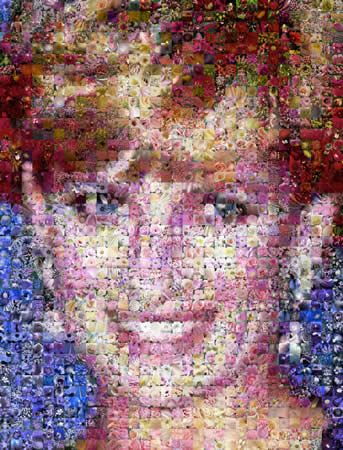
I actually know very little about the next artist (besides what is on his website).  About the extent of my knowledge of Robert Silvers is that I am fascinated by the kind of art he makes (photo mosaics-see blog post "Time Flies!...When you throw your clock away.") 
Again, curiosity is the strongest force behind this decision, but I suppose there could always be worse motivators.

and

Augustin Pajou

The third artist I chose to consider is Augustin Pajou. From out of left-field I know - a French Neoclassical Sculptor from the 1700s.  I have always had the greatest respect for sculpture, and sculptors.  The idea of carving something from a solid block in particular always takes my breath away.  The reason Pajou comes to my mind in particular is that last year we were assigned to go to any museum that contained art in D.C. to choose some pieces to write about for AP Literature.  I love going to museums, and it was really easy when I didn't live two hours from D.C. as I do now...that project however made me realize that when I used to look through museums I would usually forget to look for an artists name, so even if I remembered the title of the piece I would have to look for the work through Google Images to i.d. the piece in particular that I had seen/liked in the case that multiple artists named something the same.  One statue that grabbed my attention was Pajou's "Calliope".  I had to remember the artists name as well as the pieces name for the assignment and when I went online to find an image of the sculpture I found many of Pajou's other works beautiful as well.  I really can't get over the look of her flowing garb, I mean that's MARBLE! 

  
(Sorry about the spacing on the last part, it won't readjust for anything right now :S)

Thursday, October 7, 2010

Heather Harvey!

Tuesday afternoon I attended the talk given by Heather Harvey.  She started her talk with a disclaimer of sorts telling us how she is frequently asked what her work means.  She went into great detail about how she is interested in "the human condition", especially aspects of which remain "unresolved".  She told us that she wants her work to "overlap" a number of categories/ideas, and hopes to create works that allude to a "variety" of things and "suggest something larger".   She explained further, pulling her background and interests into play...she informed the audience that she has always been interested in how the world works. Well read, or at least 'well researched', Heather referenced many well known figures in her description of her thought process- at one point even (reluctantly quoting Einstein!).  She made/quoted one point in particular that really resonated with me.  Using video games as her analogy, she presented the world as a well designed place that looks as though it works, but when you zoom in(on places that are not intended to be seen close up, like backgrounds...) the system breaks. The world from a human level makes sense, but as soon as you change perspectives everything gets very confusing(you come up against quantum physic, etc.) She used this point to turn back to her interests.  She shared that she likes focusing on things in between what we consider "known" and the "unknown" parts of our world.  The pictures of her pieces that she had with her were from a recent show "Into the Honeyed Presence Strewn".  Heather described parts of the works as attempting to capture the "chaotic ways of memories", which resulted in forms pushing out from the walls, that proved both playful and almost threatening in appearance.  This also had to do with "unseen infrastructures" such as gravity, quantum physics, and even human emotions...Some of the last things she showed us were her "Hole Drawings" in which she drilled through walls, usually former displays revealing many layers and at the same time creating a design with the holes.  One that I found particularly interesting was one she created by overlapping two Smith Charts (electrical engineering tool).  Lastly she described how she makes some of her "dumb art".  The plaster and wax pieces, and the liquid plaster she pushed through burlap, all created things that looked so different than one might expect if the process was just described without a visual example of the result (a pleasant surprise nonetheless).  Assigning meaning to these last pieces was equally challenging, according to Heather, as were the wall works, however, she did say that they could be looked at as dealing with mortality, and how it is or is not contained in the human body, and how they could be perceived as both playful and morbid works-it ultimately depends on varying perspectives, which seems to be her big point.
I have trouble recalling any other artist in particular that Heather Harvey makes me think of...I cannot say I have ever heard any one admit that they do not always have a concrete idea/message behind a piece and they want it to be ambiguous, they want it to be open to interpretation, either.  However, I found that unbelievably refreshing!  This is as close as my ideas have ever come to "relating" to another artist's.  I loved hearing her talk about trying to capture the essence of things unseen, unproven, unquestionable...I am fascinated by those concepts, and trying to create these things is so "cool" in my mind!


(I'd also like to apologize for the overuse of exclamation points in my most recent blog titles...I just noticed today that I had used them in almost all of my titles.)

Saturday, October 2, 2010

Time Flies!...When you throw your clock away.

Last week we continued a bit more with "futurism" watching parts of "Man With a Movie Camera".  (The website where people can upload "modern" equivalents to scenes from the movie was really neat!)  It was strange seeing such old film "move" so differently from what one is used to seeing...I can only imagine seeing the film when it was originally made- how strange that must have looked.  While we watched, we also started to make collages from magazine clippings and our model sketches.  When we finished them on Thursday (I thought) it was interesting to see how differently each one turned out, even though we technically started with the same materials.  
Between classes we also sketched more to our instrumental music, read an excerpt from Scott McCloud's "Understanding Comics", and planned our postcards.
I had trouble choosing just one song to sketch to, but I eventually stuck with Heat by Apocalyptica.
 
The first few sketches I did, I found myself drawing objects that I thought of when I heard the music, mainly violins. So I set the song to repeat, and simply let it repeat for an hour...after a while I stopped noticing where it was in the song, as it started to blur together.  Then I sketched a few more pages (this time with colored pencils instead of oil pastels).  Not only was sketching with the pencils faster and easier, I stopped drawing objects, and found myself drawing lines that interacted with each other as the sounds did instead.  
The Scott McCloud excerpt was very different from our past reading assignments.  It was fun to read a coherent argument in comic form, that literally guided you (the reader) through the examples, talking about time in comics, by showing the narrator walking through different instances of time in comics.  I found it particularly interesting on page 108 (or 15/24) that the author had the narrator standing in front of representations of some well known futurist pieces. I also found it interesting that a line could become so stylized that it was almost universally associated with a particular action.
The collages we made led me to my research topic this week.  I was not sure
exactly what they were called, but after some searching I pin-pointed that
images made up of many smaller images (in my mind, like a super collage) are generally referred to as Photo Mosaics. Like this one for example:
 
(Close up)
 
I was also curious when they first became "big", for lack of better words.  Apparently in the 1970s,  "Leon Harmon of Bell Labs wrote article, entitled 'The Recognition of Faces', that appeared in Scientific American. To prove that very little detail was required for humans to recognize a face, he included a low resolution rendering of a grayscale Abraham Lincoln. This image of Abraham Lincoln was simply 252 tiles of varying shades of gray."  This grew into more complicated images that we see today, however,"Now, virtually all photo mosaics are made with computers, using advanced algorithms to place tile pictures in their preferred locations."  I think it would be fun to make one by hand some time, of course it would take a while.
 Resource 1  Resource 2  Resource 3  

I'm sorry if my questions this week seem rather simplistic...
-When making a collage: Can one simply throw things together, and later draw meaning from it--perhaps assuming that even though there was no initial driving idea that eventually one subconsciously chose particular things?
-In reference to the instrumental sketches:  How much of a difference does it make if one is hearing something for the very first time, or if they are familiar with it.  (In English) How differently might one react initially to something compared to someone that has positive/negative associations with a song, or sounds of the song (one may never had heard the song before, but if it sounds similar to another one...)-essentially, I suppose I am curious how much our experiences/emotions may affect how we "read" (react) something (or if there is even a way to "measure" such things.)