Between classes we also sketched more to our instrumental music, read an excerpt from Scott McCloud's "Understanding Comics", and planned our postcards.
I had trouble choosing just one song to sketch to, but I eventually stuck with Heat by Apocalyptica.
The first few sketches I did, I found myself drawing objects that I thought of when I heard the music, mainly violins. So I set the song to repeat, and simply let it repeat for an hour...after a while I stopped noticing where it was in the song, as it started to blur together. Then I sketched a few more pages (this time with colored pencils instead of oil pastels). Not only was sketching with the pencils faster and easier, I stopped drawing objects, and found myself drawing lines that interacted with each other as the sounds did instead.
The Scott McCloud excerpt was very different from our past reading assignments. It was fun to read a coherent argument in comic form, that literally guided you (the reader) through the examples, talking about time in comics, by showing the narrator walking through different instances of time in comics. I found it particularly interesting on page 108 (or 15/24) that the author had the narrator standing in front of representations of some well known futurist pieces. I also found it interesting that a line could become so stylized that it was almost universally associated with a particular action.
The collages we made led me to my research topic this week. I was not sure
exactly what they were called, but after some searching I pin-pointed that
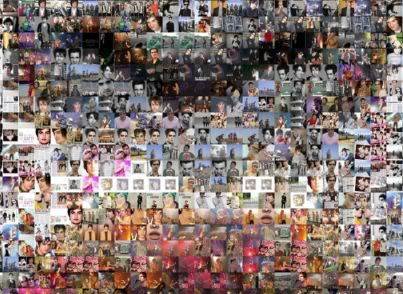
images made up of many smaller images (in my mind, like a super collage) are generally referred to as Photo Mosaics. Like this one for example:
exactly what they were called, but after some searching I pin-pointed that
images made up of many smaller images (in my mind, like a super collage) are generally referred to as Photo Mosaics. Like this one for example:

(Close up)
Resource 1 Resource 2 Resource 3
I'm sorry if my questions this week seem rather simplistic...
-When making a collage: Can one simply throw things together, and later draw meaning from it--perhaps assuming that even though there was no initial driving idea that eventually one subconsciously chose particular things?
-In reference to the instrumental sketches: How much of a difference does it make if one is hearing something for the very first time, or if they are familiar with it. (In English) How differently might one react initially to something compared to someone that has positive/negative associations with a song, or sounds of the song (one may never had heard the song before, but if it sounds similar to another one...)-essentially, I suppose I am curious how much our experiences/emotions may affect how we "read" (react) something (or if there is even a way to "measure" such things.)


No comments:
Post a Comment